Preface
Abbreviated Sources
and References
Annotations: title,
epigraph and
dedication
Part I
I.1 Synopsis
pp. 3-21
pp. 23-28
pp. 29-46
pp. 47-62
I.2 Synopsis
pp. 63-68
pp. 69-77
I.3 Synopsis
pp. 78-93
pp. 94-123
pp. 124-153
I.4 Synopsis
pp. 154-168
I.5 Synopsis
pp. 169-187
pp. 188-201
I.6 Synopsis
pp. 202-221
I.7 Synopsis
pp. 222-256
pp. 257-277
Part II
Part III


I.4 pp. pages 154-168
154.epigraph] Les femmes soignent [...] Rimbaud: Arthur Rimbaud (1854-91), precocious French symbolist poet. The quotation is from his major work, A Season in Hell (1873), a prose-poetic vigil through the dark night of the soul: "I'll return with limbs of iron, dark skin and furious eye; people will think to look at me that I am of a strong race. I will have gold: I will be idle and brutal. Women nurse those fierce invalids, home from the hot countries. I'll be mixed up in politics. Saved" (from part 2: "Bad Blood" [epigraph italicized], trans. Louise Varèse).
155.7] an Italian Renaissance: later identified as Lady of the Junipers (168.10).
156.7] The most difficult challenge [...] ceases to be an ideal: a condensation of LWW, book 6: "The Myth v. Marriage."
156.16] a bit of verse [...] concerning Petrarch and his Laura: probably this couplet from Byron's Don Juan (quoted in ODQ): "Think you, if Laura had been Petrarch's wife, / He would have written sonnets all his life?" Lord Byron's name, George Gordon, probably provided that of Otto's Byronic protagonist.
156.17] Virginia [...] Paul: from Paul et Virginie (1788), the famous idyllic romance by the French writer Jacques Henri Bernardin de Saint-Pierre (1737-1814). Otto didn't read the novel very closely, for Paul does not in fact see Virginia drown, and she's fully clothed throughout the ordeal. Virginia prefers death to immodesty, not to marriage.
160.8] sursum corda: Lat.: "lift up your hearts" (from the Mass); used similarly at 332.6.
160.27] Enesco's Third Rumanian Rhapsody played on a harmonica: Georges Enesco (1881-1955), Rumanian composer; he wrote only two Rumanian rhapsodies, so either his Third Symphony is meant or (more likely if played on a harmonica) the reference is facetious.
160.30] Saint Paul would have us redeem time: see 144.38.
160.30] present and past are both present in time future [...] no redemption but one: from the opening of Eliot's "Burnt Norton," the first of Four Quartets: "Time present and time past / Are both perhaps present in time future / And time future contained in time past. / If all time is eternally present / All time is unredeemable."
160.37] Two years isn't long, not if you say it real fast: a remark Gaddis heard while in Central America in 1947-48 and quoted in his brief memoir "In the Zone" (New York Times, 13 March 1978, 21; rpt. in the first edition of this Reader's Guide, 301-4). Several details in this chapter and III.1 were reused in the memoir.
162.6] Quién limpian mi cuarto mañana: "Who cleaned my room this morning" is what Otto means to ask, though his Spanish here and throughout the chapter is usually incorrect (for example, limpian should be limpió).
162.12] Hay visto una manuscripta aquí?: "Did you see a manuscript here?" (should be "¿Han visto un manuscrito aquí?")
162.16] Qué dijo?: "What did he say?"
162.17] playa: "beach"; the word Otto wants is pieza or drama.
162.24] El está para la máquina [...] Esta mañana: "It was by the typewriter [...]. This morning" (should be "Estaba junto . . .").
162.29] Qué cosa?: "What thing?"
162.30] Papel [...] al máquina: "Paper. [...] Paper on which I wrote my beach on the typewriter."
162.41] No entiendo: "I don't understand."
162.43] Tiemplo: that is, tiempo.
163.7] Pero sí: "But of course."
163.13] Lo pusé aquí [...] o se ensuciara: "I set it [should be puse] here when I was packing, everything was so unraveled that I was afraid that it would get lost, or get dirty."
165.39] La limpia: "Clean them?"
166.11] Una limosnita, por el amor de Dios: "A small almsgiving, for the love of God." (If Gaddis didn't hear this himself in Central America or Spain, he would have read it in Borrow's BS [72].)
166.17] Dios se lo pague: "May God repay you."
168.10] Lady of the Junipers: a 15th-century painting "attributed now to Verrocchio, but formerly to Lorenzo di Credi, and by several very earnest students claimed for the young Leonardo," Sirén writes in Leonardo da Vinci (p. 24), and which is reproduced facing his remark. He goes on to compare it to di Credi's paintings (see 128.26). [Mark Kohut]
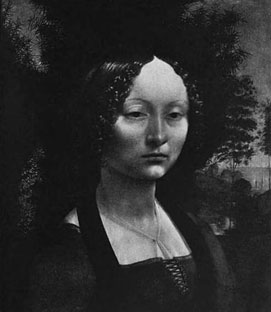
Lady of the Junipers
from Osvald Sirén's Leonardo da Vinci: The Artist and the Man
168.25] girl who loved her brother the sun: in his discussion of sun-moon/brother-sister stories in the chapter on "Star-Myths," Lang notes: "On the Rio Branco, and among the Tomunda, the moon is a girl who loved her brother and visisted him in the dark. He detected her wicked passion by drawing his blackened hand over her face. The marks betrayed her, and, as the spots on the moon, remain to this day" (Custom and Myth, 132-33). [Jed Kelestron]