|
|
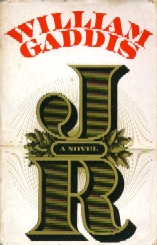
J R
|
||
|
J R |
Twenty years after his first
novel, and after twenty years of working for the government and big
business, Gaddis produced his highly acclaimed second; the prize-winning
J R, another huge book of 726 pages containing very little except
dialogue. A number of critics have said that this is the novel which comes
closest to catching the varieties of spoken American English, while another
has called it “the greatest satirical novel in American literature”.
The first line of the novel gives us its theme:
“- Money...?”. J R is a satire on corporate America and
tells the story of the eleven-year-old schoolboy JR Vansant who builds
an enormous economic empire from his school's public phone booth, an empire
that touches everyone in the novel, just as money - the getting of it,
worry about the lack of it, the desire for it - shapes a great deal of
the characters’ waking and dreaming lives.
Through conversations, letters and telephone calls, we come to
understand what Marx called “the distorting power of money”, how all value
under capitalism is transformed into economic value.
The novel lays before us in immense detail, in the very grain of
the human voice, the alienation that is part and parcel of a world in
which our innermost feelings have been commodified and where money has
become fetishized; rather than it being simply a medium of exchange, a
means to an end, money has become an object of desire for its own sake,
an outward sign of success and power.
The novel draws on a huge range of social and economic thinkers
from Marx, a phrase of whose hangs over the entrance to JR's school, to
Max Weber, George Simmel and George Bernard Shaw, whose interpretation
of Wagner's Ring as an allegory of the rise of capitalism is central to
J R. The novel is far more than a tissue of references to other works, however. The way in which JR’s growing paper empire impinges on the lives of the other characters allows Gaddis to explore a number of themes that will be familiar from his first novel. Around the central figure of JR are educators, writers and musicians and through their greed and need we see how human relationships are torn asunder and how artistic creativity is stunted or dissipated. J R is an epic work and the second indisputable masterpiece Gaddis has contributed to post-war American fiction. |
||
from
William Gaddis: Life & Work by Peter Dempsey to complete essay |
|||
| Related materials |
J
R Cast of Characters by several hands, and being revised |
J
R: music on the soundtrack |
|
Stop
Player. Joke No. 4 |
Walter Benjamin Art in the Age of Mechanical Reproduction |
||
| JR
Goes to Washington by William Gaddis |
Agapé
Agape by Jack Gibbs/William Gaddis |
||
about Josiah Willard
Gibbs about Norbert Wiener about
Hermann Broch |
|||
Articles & essays
| His
Master's Voice: On William Gaddis's JR Patrick J. O'Donnell What Work They Do and What It Does To Them: Alienation in JR by Anja Zeidler |
The
'Protestant Epic’ and the 'Spirit of Capitalism’:
A Few Thoughts on Max Weber and Gaddis' Novel JR by Anja Zeidler |
|
|
A parody
| Writer & critic at play: William Gaddis & Gregory Comnes | ||
|
J R reading
| The
recently rescheduled JRJR Joint Reading of JR on the Gaddis-l discussion list |
||
Life imitates art
| The
case of Jonathan Lebed, a teenager investor strikingly similar to the character JR |
||