updated 8-12-2023
|
Gaddis continued current & recent activity Suggestions for this page are welcome: please send to postoffice at inwriting.org |
||
 |
The William Gaddis Centenary Conference | ||
 |
Lecture by William Gaddis: Novelist William Gaddis discussed American attitudes towards success and failure, on the evening of November 5, 1979, when he spoke at St. Michael's College in Winooski, Vermont. Audio of the talk can now be heard here:
| ||
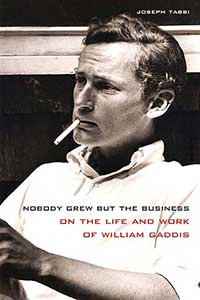 |
GADDIS BIOGRAPHY by Joseph Tabbi Nobody Grew but the Business
| ||
James Cappio recalls helping Gaddis with the accuracy of legal opinions in A Frolic of His Own in a post on The Millions. Five letters to him are included in the recently published Gaddis letters collection, selected and edited by Steven Moore (see below). |
|||
|
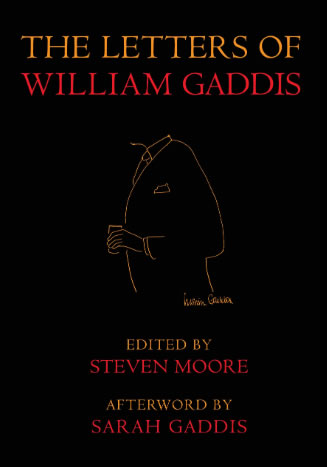
Now available...The Letters of William Gaddis, revised edition, selected and extensively annotated by foremost Gaddis scholar Steven Moore, with an afterword by his daughter, the writer Sarah Gaddis. Here's what the dust jacket says. William Gaddis (1922–98) stands among the greatest American writers of the twentieth century. The winner of two National Book Awards (for JR (1975) and A Frolic of His Own (1994)), he wrote five novels during his lifetime, including Carpenter’s Gothic (1985), Agape¯ Agape (published posthumously in 2002), and his early masterpiece The Recognitions (1955). Steven Moore is the author/editor of several books and essays on William Gaddis, and has written about many of Gaddis’s acquaintances. He is also the author of a two-volume study, The Novel: An Alternative History. Now recognized as one of the giants of postwar American fiction, William Gaddis shunned the spotlight during his life, which makes this collection of his letters a revelation. Beginning in 1930 when Gaddis was at boarding school and ending in September 1998, a few months before his death, these letters function as a kind of autobiography, and are all the more valuable because Gaddis was not an autobiographical writer. Here we see him forging his first novel The Recognitions (1955) while living in Mexico, fighting in a revolution in Costa Rica, and working in Spain, France, and North Africa. Over the next 20 years he struggles to find time to write the National Book Award-winning JR (1975) amid the complications of work and family; deals with divorce and disillusionment before reviving his career with Carpenter’s Gothic (1985); then teaches himself enough about the law to write A Frolic of His Own (1994), which earned him another NBA. Returning to a topic he first wrote about in the 1940s, he finished his last novel Agap¯e Agape as he lay dying. The recipients of the letters include other writers such as Katherine Anne Porter, David Markson, William H. Gass, Stanley Elkin, Frederick Exley, Robert Coover, Robert Creeley, John Updike, Saul Bellow, and Don DeLillo, as well as friends, family, politicians, and critics. Selected and annotated by Steven Moore, the leading authority on Gaddis’s work, and illustrated with numerous photographs, most previously unpublished, this collection stands as an essential summation of the life and work of one of our greatest authors. “If, next to God, Shakespeare created most, Gaddis runs a strong third, with especial skill in reproducing what is completely personal, particularly human, in the speech of men and women.” — Rick Moody “[Gaddis’s books] are bold, powerful . . . ambitious in conception and elegant — leonine — in execution.” — Saul Bellow “William Gaddis is pure prodigy. He has a fantastic ear for American speech with the strictest attention and exactitude such an ear demands but, strangely crossed with that, the wildest of imaginations. He is horrid and funny. [His novels] are massive in ambition and dazzling in execution. They are fierce with integrity.” — Mary McCarthy |
||
| at The New School in New York City In Celebration of William Gaddis Wednesday, February 20, 2013, 7:00 p.m. A celebration of the literary journal Conjunctions and Dalkey Archive Press's publication William Gaddis (1922–1998) is one of America’s most highly regarded writers, described by theNew York Times Book Review as “a presiding genius . . . of postwar American fiction.” He is the author of the novels The Recognitions, J R (both Dalk ey), Carpenter’s Gothic (Penguin), A Frolic of His Own (Scribner), and the posthumously published Agapē Agape (Penguin), as well as the 2002 essay collection The Rush for Second Place (Penguin). Both J R and A Frolic of His Own won the National Book Award; the latter was also a finalist for the National Book Critics Circle Award. Gaddis received a MacArthur award, and his work has been the subject of numerous critical studies.
|
|||
 |
Best of 2012 book list
My “Best of 2012″ list: 1. J R, by William Gaddis (Dalkey Archive, 2012) -Fin-
-- read more here... -- Victoria Harding |
||
A joke of some sort, or maybe they just haven't read it: J R is listed as one of "6 Works of Classic Literature That Make You Better in Business" at a slightly baffling web site called Literary Manhattan. At least they think it's a classic. The other five: Jay McInerney's Bright Lights, Big City, Joseph Heller's Something Happened, Upton Sinclair's The Jungle, Arthur Miller's Death of a Salesman, and Kurt Anderson's Turn of the Century. |
|||
D minor: the saddest chord... |
|||
 |
Mauricio Ancalmo Dualing Pianos: Agapé Agape in D Minor 2011 Mixed media. Installation © Courtesy of the Artist and Eli Ridgway Gallery |
||
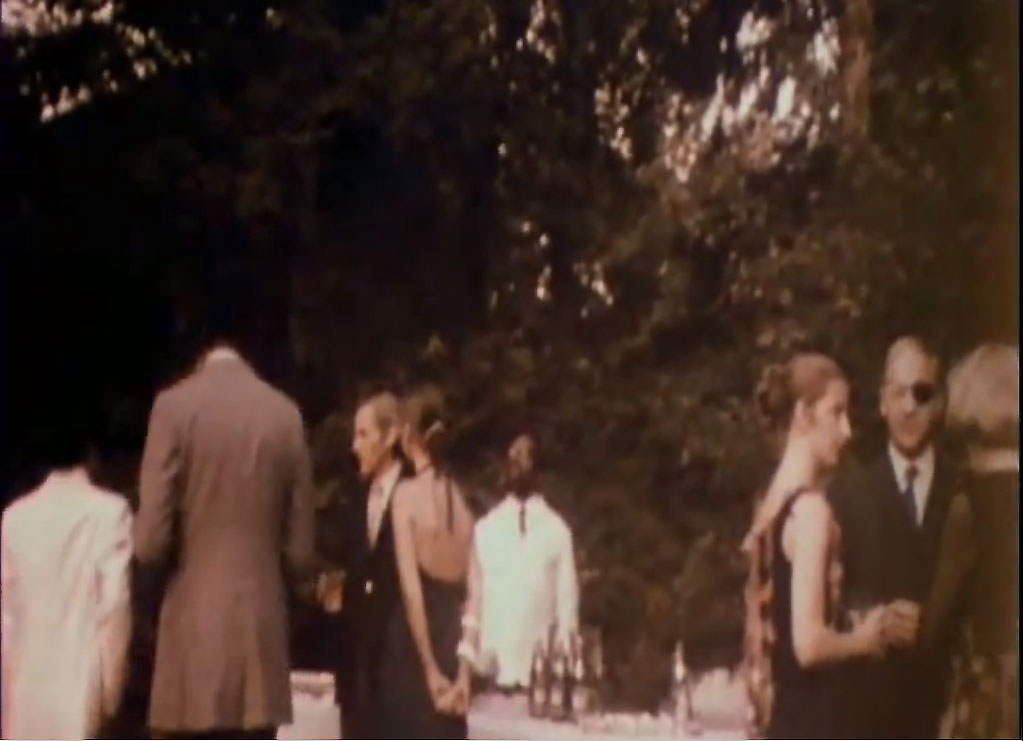
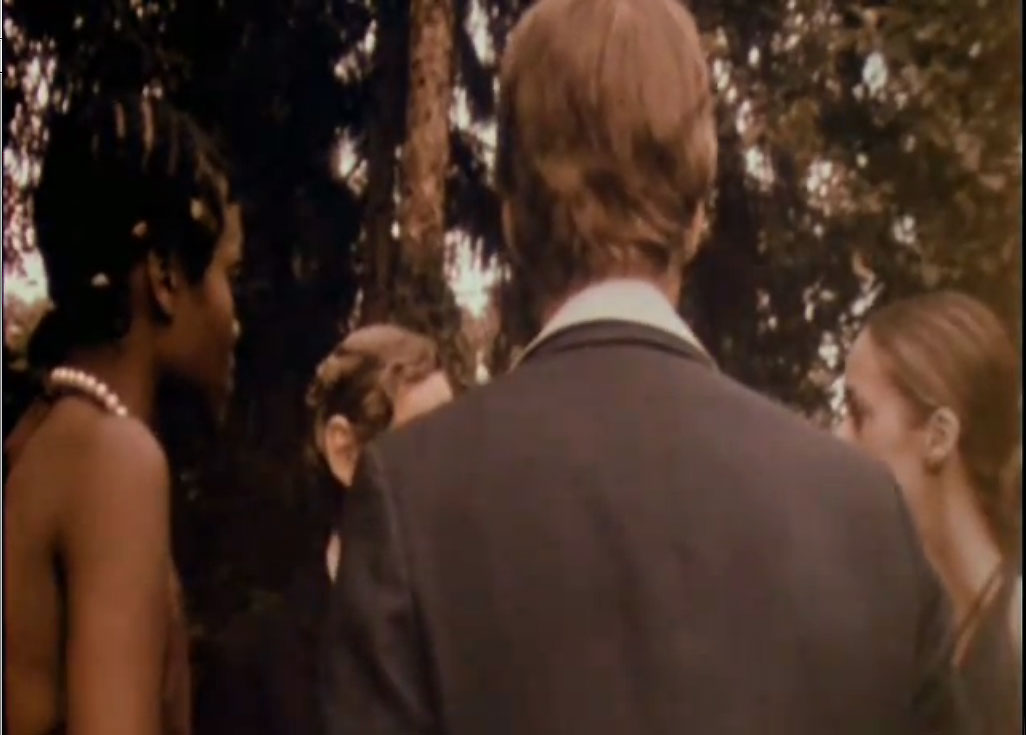
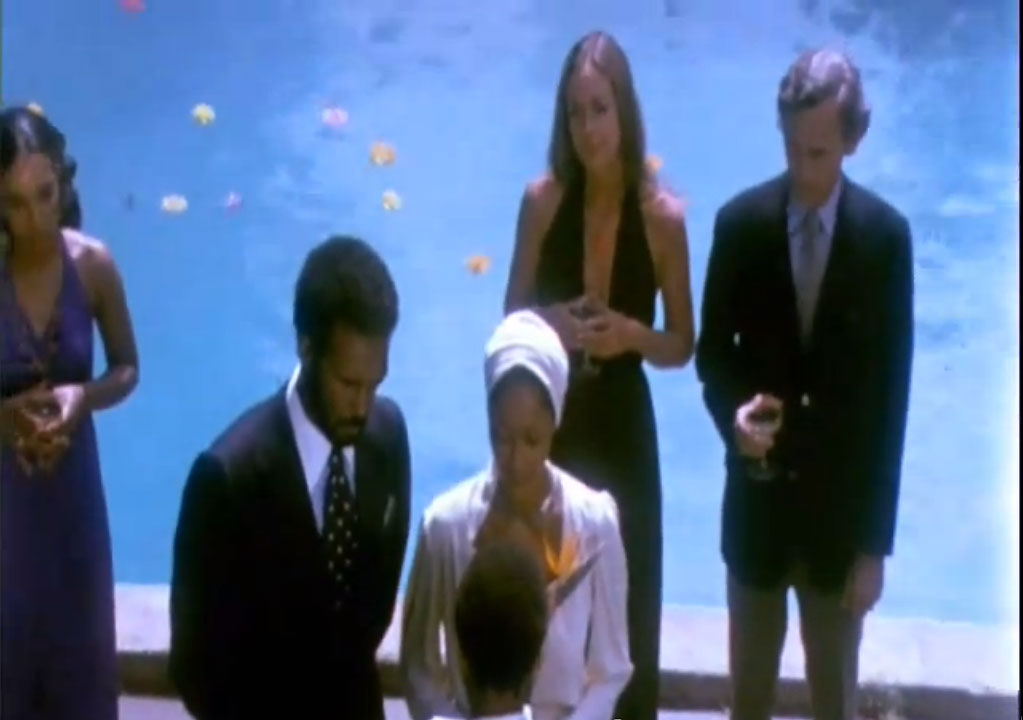
WILLIAM GADDIS RESPONDS TO CALL FOR EXTRAS for the film Ganja & Hess (1973) directed and produced by friends. A NY Times review is here. Images are taken from clips available here and here. Steven Moore & Keith McMullen |
|||
 |
 |
 |
|
New editions: |
Dalkey Archive Press is reissuing both The Recognitions and J R, scheduled for January 2012. In addition, a paperback edition of Jack Green's Fire the Bastards . will appear around the same time. And in Mexico, the publisher Sexto Piso has a Spanish edition of Agape Agape. |
||
These are the times that try men's souls, what with the world ending May 21, 2011. We've heard this before, however, and so did William Gaddis, as seen in Carpenter's Gothic. WG's first choice for the cover of that novel was the image below, which was reprinted on postcards he had a good supply of and routinely used for short communications. On the back the image is thus described::
Between the message and address areas is written:
Possibly Atlanta was the model for Anderson's painting: Gaddis reader and radio host Ed Martin (see below) writes: "I've always been convinced that downtown Atlanta, viewed from the South Expressway, is the background scene for this card. If you took out the state capitol and the old Atlanta-Fulton County stadium, everything else is the same, from the freeway curve to individual buildings." We're on the look-out for a postcard view of Atlanta to support the theory. An example of WG's use of the postcard Frank Moorman has kindly postedhere. A larger version is below; further enlargeable by clicking on it. |
|||
 |
|||
literary critic, author, and primary Gaddis scholar, will edit The Letters of William Gaddis a volume of about 400 pages of fully annotated letters (headnotes as well as footnotes for each, plus a general introduction) beginning in 1930 when Gaddis was eight years old and ending in September 1998, a few months before his death. It will contain letters to such well-known writers as Katherine Anne Porter, William H. Gass, Stanley Elkin, Don DeLillo as well as those to friends, family, and critics, and have photos from throughout his life. The publisher is Dalkey Archive Press, with a projected date of 2013. Dalkey is also issuing new editions of The Recognitions and J R. |
|||
REQUEST FOR LETTERS AND RELATED MATERIAL |
|||
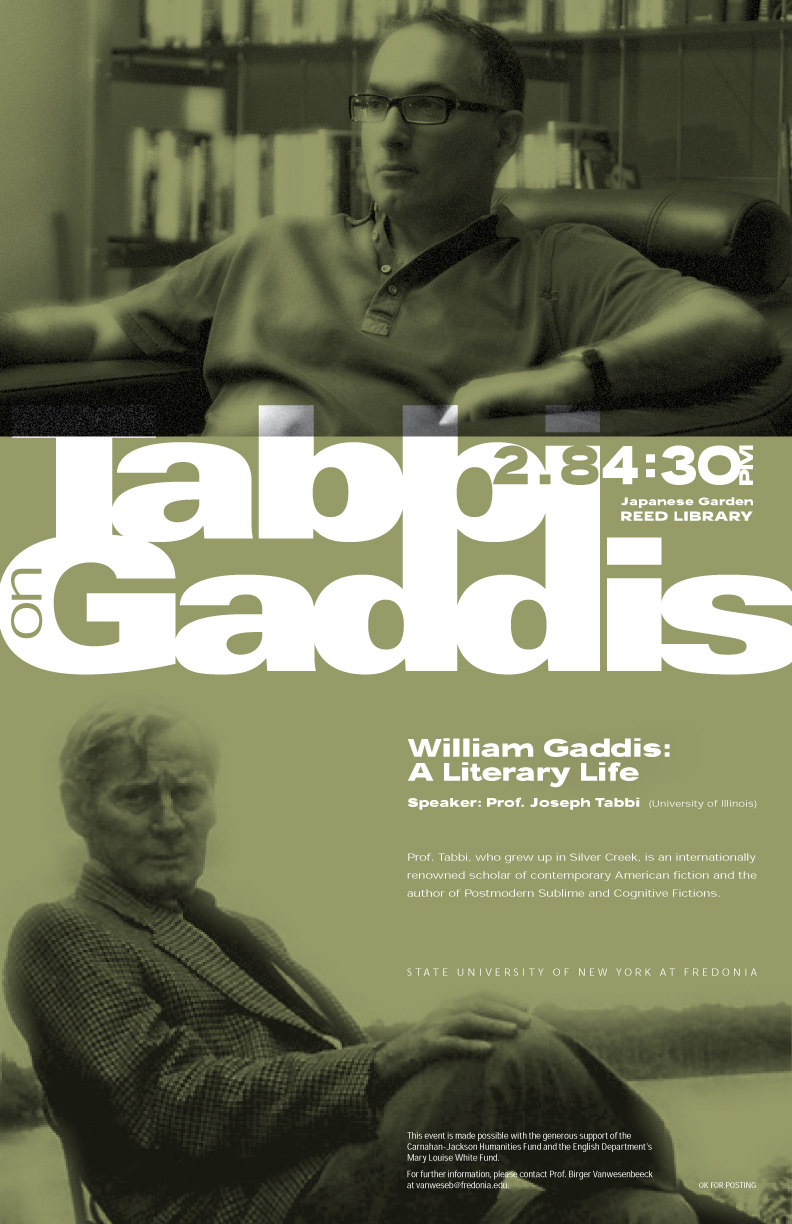
William Gaddis biography underway Gaddis scholar Joseph Tabbi is working on a biography to be titled William Gaddis: A Literary Life, expected to be ready in late 2013. It was commissioned by. Northwestern University Press. The author will give a lecture on Gaddis held by the English department of the State University of NY at Fredonia on February 8th; details here. |
 |
||
| -- in a Christmas eve inerview at radio station KDVS (University of California Davis) on the show Speaking in Tongues, Steven Moore talked with Ed Martin about William Gaddis's novels and what seems to be their near-eerie prescience, perhaps most especially J R's portrayal of financial shenanigans and chutzpah, but also the activities of the religious right in Carpenter's Gothic and the endless litigation of A Frolic of His Own. You can listen to it (mp3 format) from this site by clicking HERE. -- Victoria Harding
|
|||
 |
The Recognitions and J R out on audio books Available from Audible, with samples available on their site, the recording of J R has gotten a wonderful review from The Neglected Books Page blog should quell the doubts of those, like me, who didn't think this could be done right. At left, actor Nick Sullivan. -- Victoria Harding. |
||
| From NEW YORK— Muriel Oxenberg Murphy , the co-founder of the American painting and sculpture department at the Metropolitan Museum of Art, died two weeks ago of cancer, Artnet reports. Murphy, 82, joined the Met in 1949 and helped establish the department under the guidance of Robert Hale. In the 1970s, she became known for her New York salon, which brought together many important literary and art world figures. She edited the collected writings of the novelist William Gaddis, who was her companion for more than 20 years starting in the '70s, and a collected volume of her writing, Excerpts: from the Unpublished Files of Muriel Oxenberg Murphy , was published in July. -- Victoria Harding |
|||
 |
The Argentinian-born novelist Rodrigo Fresán has been selected to introduce the Spanish-language edition of Agape Agape, translated by
Miguel Martinez-Lage, who has also translated J.M. Coetzee,
and to be published by Sexto Piso. Fresán's most recent novel to be translated into English is Kensington Gardens. |
||
| Good news for all who gave up! Gregory Cowles reports in the NY Times Book Review's Paper Cuts blog that he has at last read Carpenter's Gothic, and finds that "Gaddis is not in fact all that difficult." The blog was written just before he was named editor at the Times Book Review, so there may be a causal effect there, and one can only hope he reads the other four novels; his life may change again thereafter... |
|||
The publisher of many "illustrious writers," including Gaddis, Robert Giroux is dead at age 94: the NY Times obituary is here, with a link to their page on Gaddis, which in turn has links to extensive materials from their archives, including contemporary reviews of Gaddis's books and other articles, and to Gaddis material on other sites. . |
|||
| 79 Horatio Street, the building where Gaddis lived in his Village days, on the street where Wyatt Gwyon had his studio, has been sold: read more about the sale, and the building's rather colorful history, here. --Peter Dempsey View Larger Map |
|||
Ninth Letter, a beautifully produced literary and arts magazine published semi-annually by the University of Illinois, Urbana-Champaign, has published the Gaddis story, "In Dreams I Kiss Your Hand, Madam" in its Fall-Winter 2007 issue, and it has been reprinted in Harper's Magazine in its Readings section in August 2008. It's available on line here |
 |
||
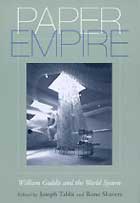
| A collection of essays on Gaddis's work, Paper Empire: William Gaddis and the World System, edited by Joseph Tabbi and Rone Shavers, has been described (at www.findarticles.com) as "a collection of
papers and other materials takes up the gap in scholarship on Gaddis's approach to aesthetics, systems, media and capital and includes two biographical pieces as well. They include an interview with Gaddis from about 1980, Gaddis's intellectual relationship with Kierkegaard, his approach to the encyclopedic novel, and to dialogue, his aesthetics of cybernetics (to the first and second order), his place n the autopoiesis of American literature, cognitive gothic relevance theory and its iteration and style, Gaddis's transition to postmodernism, his cognitive map, the debates around him, and the remarkable commentary on the media in such works as Agape Agape. This makes Gaddis more famous, but just as delightfully difficult." Full information, including a list of essays, here. |
 |
||
Torschlusspanik, the German broadcast version of Agape Agape, translated by Marcus Ingendaay, directed by Klaus Buhlert, and performed by Ignaz Kirchner, originally broadcast in 1999, was re-broadcasted on 19th November 2005 on Deutschlandfunk. During the summer of 1997, when he visited the German-American
Festival for Literature, "Crossings," in Cologne, Gaddis was persuaded
by Elisabeth Pankin to write a play for DeutschlandRadio, where she
was director of radio plays. Gaddis was surprised because, as he rmarked,
"radio
is something you listen to in cars." Pankin was expecting
a collage for many voices, something coming close to
party scenes in The
Recognitions , but got instead a monologue. Her disappointment
passed during production, and in the end all involved
knew that they had taken part
in something great and important. |
|||
| 50th
anniversary of The Recognitions |
|||
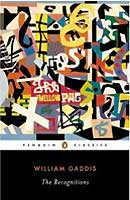
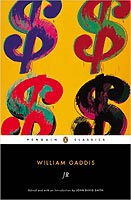
Penguin reissues The
Recognitions and J R with surprising cover art. |
|||
  |
|||